
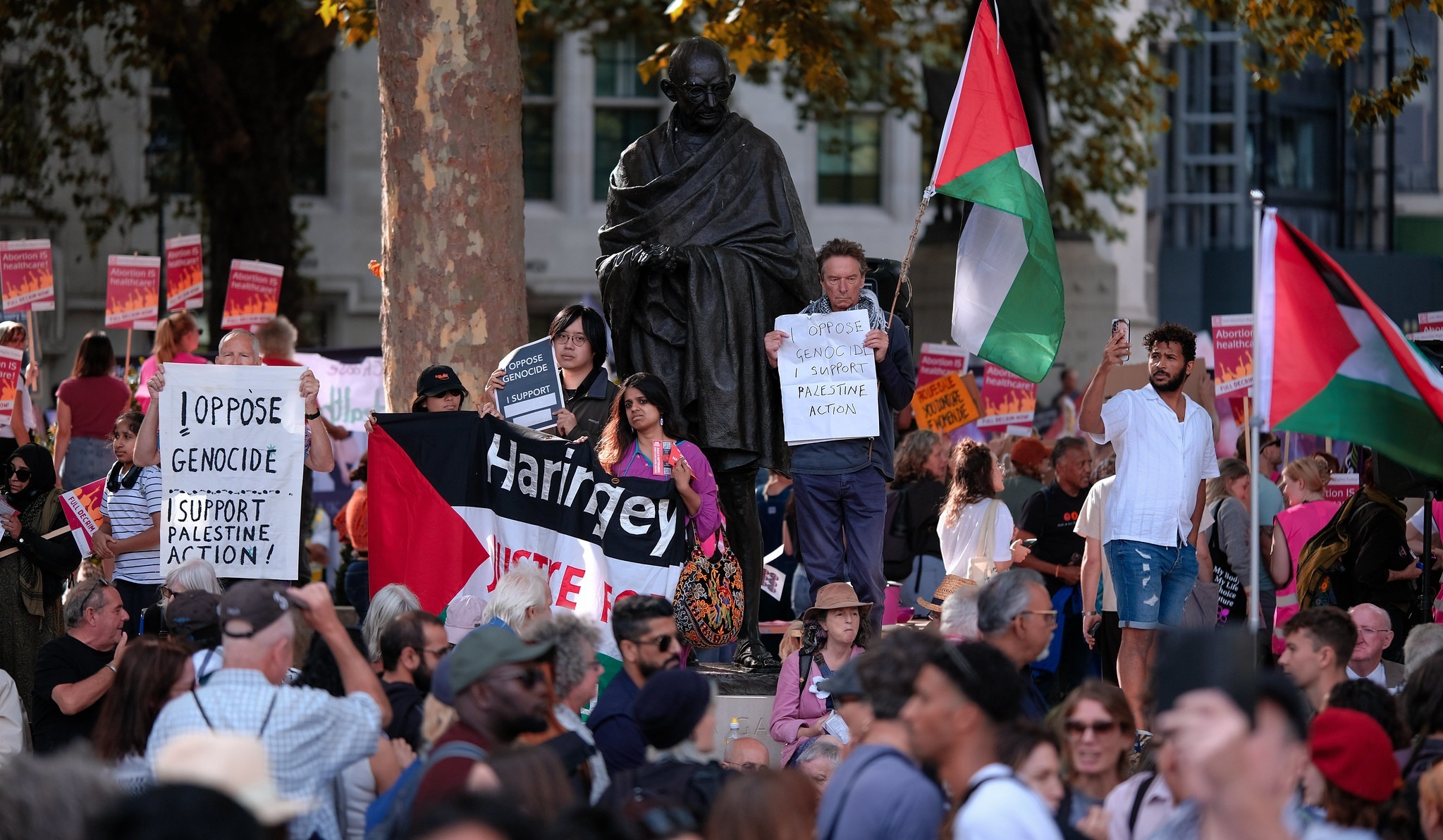
The High Court last week held that the Home Secretary had acted unlawfully in proscribing (banning) the action group Palestine Action under s.1 of the Terrorism Act 2000: Ammori v Secretary of State for the Home Department, 13 February 2026. Nonetheless, the effect of that proscription will remain in place until the end of February, when a further hearing will take place to discuss what happened next, including the possibility of a government appeal to the Court of Appeal.
The decision of the High Court was welcomed by Palestine Action and by those who support the right of free speech and the right to demonstrate, but the real importance of the decision is what it tells us about the difference between penalising unlawful protest action, and criminalising a particular group (and those who support that group) independently from any unlawful actions.
Proscribing Palestine Action
Palestine Action was proscribed as a terror group by the UK government in July 2025 under s.1 of the Terrorism Act 2000, which allows the Home Secretary to proscribe an organisation if it commits, prepares for, promotes, encourages or is “otherwise concerned” in acts of terrorism. An act of ‘terrorism’ is defined as the use or threat of violence or damage to property designed to influence a government or intimidate the public to advance an ideological cause. As the purpose of the group was to lend support to the Palestine cause in and against Israel, the government felt that that criterion was satisfied. Thus, the government voted to proscribe the group weeks after the group’s activists broke into an RAF base and spray-painted two military aircraft, resulting in £7m of damage.
The consequence of a proscription includes being a member of that group, and, of particular relevance to the action in judicial review, below, expressing support for a proscribed group (under s.13 of the 2000 Act). Thus, many protestors who help up placards supporting the group were arrested under the Terrorism Act, and many were detained in prison awaiting trial.
The High Court’s ruling
The group challenged the Home Secretary’s proscription before the High Court, claiming that it was an unlawful use of her powers under the 2000 Act, and a disproportionate interference with the rights of freedom of expression and the right to peaceful assembly; protected by Articles 10 and 11 of the European Convention on Human Rights, as given effect in domestic law by the Human Rights Act 1998.
Upholding the claims, the High Court ruled that when the then-Home Secretary (Yvette Cooper) decided to ban the organisation last June, she had failed to first take into account what impact that decision would have on the right to protest; thus, the impact of any ban on free speech and peaceful assembly. The High Court also found that she had not fully followed her own policies regarding the test for when an organisation should be proscribed under the Terrorism Act.

Now the Foreign Secretary, Rt Hon Yvette Cooper MP was the Home Secretary who proscribed Palestine Action in 2025. Photo: House of Commons, CC BY-NC-ND 4.0
The High Court held that the organisation had no human rights defence to the incidents that led to the decision to proscribe, for example breaking into arms firms linked to Israel, leading to charges of criminal damage However, although the legislation permits ministers to ban a group which causes serious damage to property in order to further their cause, a critical issue in the present case was whether the ban impacted disproportionally on the rights of others to protest in support of issues in Palestinian affecting the Palestine cause. Thus, Dame Victoria Sharp accepted that the fact of proscription and the heavy penalties meant that it is reasonable to expect people to be risk averse, to adjust their behaviour and to avoid doing things that run any significant risk that they might commit any of those criminal offences relating to supporting the group.
Although the judges felt that “a very small number” of Palestine Action’s activities met the legal test for acts of terrorism under the statutory definition, they felt that the standard criminal law could be used to confront the group, without resorting to the exceptional power to proscribe that group under the 2000 Act. Thus, the proscription was disproportionate to the aims of public safety and national security sought by the ban, as the nature and scale of Palestine Action’s activities falling within the definition of terrorism had not yet reached the level, scale and persistence to warrant proscription.
Despite that finding, the High Court ruled that the ban of Palestine Action under terrorism legislation is unlawful, it ruled that the ban remains in place until the court considers the next steps; in particular whether the government wishes to appeal the finding to the Court of Appeal. Thus, in the meantime, expressing support for Palestine Action or taking part in its activities will remains a serious criminal offence.
Proscription, freedom of expression and freedom of peaceful assembly
The power to proscribe a particular organisation, and thus criminalise its activities, membership and the activities of others in support of the organisation, is a form of ‘prior restraint.’ Thus, instead of waiting for the group, or its supporters, to commit a breach of the regular law (trespass, criminal damage, obstruction of the highway, etc.), a proscription order will allow the automatic application of anti-terrorism law to that group, its members and those supporting it. This obviously has a ‘chilling effect’ on the right of association, peaceful assembly and freedom of expression, as those who are affected by the ban will desist from becoming members or lending support to its views. Although this form of restraint is not automatically in breach of human rights, exceptionally strong and convincing evidence should be present to justify it.
Further, if people are willing to disobey the proscription order, they will face severe penalties under the 2000 Act, often for an activity that would not be a breach of the general public order laws. For example, thousands of people have been arrested, and some charged under the 2000 Act, for holding up signs declaring support for Palestine Action. Such actions are, generally, entirely peaceful, and are not likely to be in breach of even the lowest level of public order offences (s.5 of the Public Order Act 1986). Yet, if that group is proscribed, that activity appears to be a breach of the 2000 Act, and the police do not have to show that the activity has caused any further harm beyond supporting the group.
That begs the question whether the group’s existence and previous activities warranted the measure of proscription? The question is important for the group and its members, for they will be committing a breach of the 2000 Act however they go about their activities in the future. Palestine Action had committed several acts of severe damage to property before their proscription, and under the 2000 Act the group appeared to come withing the, very wide, definition of terrorism – acts of violence and damage to property intended to further an ideological change. Indeed, the court in the present case accepted that some of its activities came within the 2000 Act. However, in the court’s view those activities – which could have been dealt with under the general law – did not cross the threshold under the Act to warrant proscription.
The courts’ role in reviewing proscription orders
On a strict interpretation of the Terrorism Act 2000, Palestine Action appeared to be a proscribed group, and its supporters clearly were supporting its cause. So how is a court allowed to decide that the act of proscription was unlawful? The traditional principles of judicial review allow the courts to question the legality and rationality of the Minister’s decision. In this case, the Minister appeared to depart from her original reasons for prescribing groups, and, arguably, had failed to take into account relevent facts and policy. On the other hand, it is unlikely that without resorting to human rights law (the 1998 Human Rights Act) that a judge would find that the Home Secretary had ‘taken leave of her political senses’ in deciding to proscribe this group.
The courts’ role in reviewing the minister’s decision is now clearly focused on judging its compatibility with the rights in the European Convention on Human Rights, and its powers of review under the Human Rights Act 1998. Whether the wording of the 2000 Act was clear, the domestic courts are now allowed to ask the following questions: was the use of that statutory power proportionate and necessary in a democratic society to achieve the aims of the Act itself and the reasons the Minister gave in using the legislation? In addressing those questions the court is allowed, under s,2 of the 1998 Act, to take into account the jurisprudence of the European Court in this area, and to consider the fundamental importance of the right in question, together with the constitutional and democratic dangers involved in an act of proscription. Thus, it is relevant to ask whether any subsequent appeal to the European Court would be successful (perhaps causing an international conflict between the government and the council of Europe)?
Equally important is the question whether the measure of proscription is damaging to our own constitutional values and feelings of justice? The domestic courts are supposedly the guardians of our fundamental rights, and in the past have ruled as unlawful detention without trial (even at a time of national emergency), and the acceptance of torture evidence in deportation proceedings; the government failing to provide convincing evidence for such measures. Domestic courts are no strangers to protecting human rights (or civil liberties as we once called them) and legal justice – witness their enforcement of the basis rules of natural justice and the duty to act fairly, and their insistence that everyone should have access to the courts and legal representation. Such judicial powers have been buttressed by the European Court’s rulings, and the passing of the Human Rights Act 1998, but were part and parcel of the domestic judiciary’s belief in freedom and justice.
Conclusions
The present decision will cause a great deal of anxiety to an already beleaguered government. It will also, no doubt, reignite dissatisfaction from those who advocate the reform of the Human Rights Act and the withdrawal of the UK from the Council of Europe – the retreat from European human rights law. The government has clear plans to appeal the decision, but it is to be hoped that the Court of Appeal, and the Supreme Court, will remind us of the dangers of reactionary and disproportionate measures to deal with a situation that needs to be resolved within the regular law and not via exceptional anti- terrorism law.
The decision to proscribe the group was perhaps genuinely introduced by the government, at that time, to be necessary in protecting national security and public safety. However, now that the courts have provided judicial guidance on legality and reasonableness of such measures, to add to the political and public criticisms of the decision, it is not the time to press on with the measure. What is surprising is that a government headed by a former human rights lawyer, and author of a leading textbook on Convention rights, needed that reminder at all.

Header photo: Alisdare Hickson, CC BY-NC-ND 4.0
Leave a Reply