
I am thrilled to announce the publication of my new chapter, “Creative Industries”, featured in the recently released Routledge volume, Legal Frameworks for Artificial Intelligence in Industry. Here is a brief overview of the key themes I explore:
As an innovative and advanced technology, artificial intelligence (AI) has been extensively studied, tested, and implemented across diverse sectors, notably within the creative industries. Musical compositions “generated” by systems developed by various tech companies not only offer a glimpse of the future of the digital music world but also create conceptual clashes regarding the interpretation of established terms, such as “authors” and “composers”, within traditional copyright frameworks. Similar major changes are happening in dance, film, and the wider creative economy. For instance, questions arise concerning the degree of creativity involved when a user selects and combines dance steps and styles within an AI application to ultimately generate a dance video.
It is debatable whether AI systems truly “create” music and other artistic outputs, like audio-visuals and choreography, in response to human prompts. Consequently, who is the author or beneficiary of AI-generated music and other artistic works, and whether copyright law is an appropriate means of protecting such outputs, have become questions of global concern.
Three levels of AI creativity
To better understand whether these new outputs can be protected by copyright, the chapter divides AI’s creative abilities into three levels. First, AI-supported systems strictly follow rules set by humans, keeping human authorship clear. Second, AI-assisted tools use huge amounts of data and machine learning to create surprising results, blurring how much humans actually contributed. Finally, AI-generated systems can create works independently, without human input, directly challenging our traditional understanding of creativity.
Who is the author?
At present, national and international law are both reluctant to recognise works made by non-humans. The Berne Convention implies that authorship and moral rights belong to humans. In the US, the Copyright Office requires human authorship for protection, as it made clear when it refused to register AI-made images from Midjourney in full. Chinese law also requires a natural person for individual authorship, while the European Union closely links originality to a human author’s personality and independent creation. On the other hand, UK copyright law offers a distinctive option by giving ownership of “computer-generated works” to the person who made the necessary arrangements for the work to be created. Meanwhile, Chinese courts have looked into treating AI outputs as “legal entity works”, giving ownership and legal responsibility to the company running the AI software.
Training data and cultural misappropriation
Beyond the basic question of who the author is, using AI creates other major legal risks, especially regarding the data used to train it. Major lawsuits from groups like GEMA and Getty Images highlight the risk of copyright infringement when protected works are used without permission or payment. Furthermore, AI generation presents acute risks of cultural misappropriation, particularly concerning the algorithmic amalgamation of Indigenous and ethnic minority traditional cultural expressions. As these complex legal issues spread through literature, photography, and design, it is clear that current copyright laws need major updates across all sectors to properly handle machine-made art.
What the chapter covers
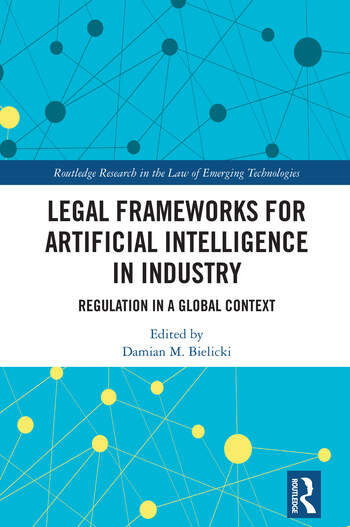
Luo Li, ‘Creative Industries’ in Damian M Bielicki (ed), Legal Frameworks for Artificial Intelligence in Industry: Regulation in a Global Context (Routledge 2027).
To explore this, the chapter uses the music industry as a main example, looking at how AI is changing the field by comparing past technology shifts with the changes AI is expected to bring. It then looks at the definition of AI and different types of AI research to judge the technology’s actual creative power. The chapter also reviews whether current copyright laws can realistically protect AI-made music and art from both a legal and practical point of view. It finishes by looking at the future uncertainties around AI music and images, using them as key examples of the bigger challenges facing the creative industries today.